
CASE STUDY: CUSTOMER SPECIFICATIONS
A plastics extrusion company manufactures complex co-extrusions for the automotive industry. Co-extrusion is an extrusion process for producing a product consisting of two textures. The materials are extruded through a single die and then fuse together before cooling to form a single part. The advantage of co-extrusion is that each material retains certain characteristic properties and combines them into a structure with multiple desired characteristics.

THE CHALLENGE
Throughout the production process, multiple variations of the co-extruded products move at a rapid speed of 12 meters per minute, or about 8 inches per second. As the products are extruded, their temperature reaches 200°F. To proceed to the next assembly stages of cutting, inspection, and packaging, their temperature must drop to 90°F or less. Due to the rapid production pace, the products needed to be cooled quickly. The company's solution was to cool the extrusions in a water bath. However, after testing this method, they discovered that traces of water remaining on the extrusions caused quality issues due to water staining.
THE SOLUTION
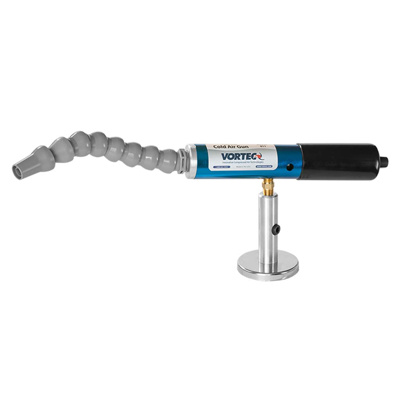
The company needed to find a better cooling solution that didn't involve water cooling but would still cool the product effectively and quickly. They turned to Vortec's air cooling solutions. After examining their application, a Vortec engineer suggested using six frost-free cold air guns. Model 621 The unit is used along the production line to cool the extrusions from 200°F to 90°F. The frost-free model was chosen to prevent water droplets from condensing on the product.
THE RESULT
When the frost-free cold air guns were installed on the production line, they proved successful in cooling the product. Initially, however, the frost-free cold air guns were used with unfiltered compressed air. During the hot summer months, condensation formed in the plant's compressed air lines. This condensation entered the frost-free cold air guns, causing several problems: freezing inside the gun reduced the cold air flow, and condensation in the exhaust air stream began to blow liquid onto the profiles. It was recommended to filter the compressed air to 5 microns and dry it to a pressure dew point of 40°F or less. The company integrated these compressed air treatment steps into its production process, thereby eliminating the problems. After these changes were implemented, the company was able to cool its extrusions quickly and effectively without compromising product quality.
HOW THE FROST-FREE COLD AIR GUN WORKS
Vortec's frost-free cold air guns utilize vortex tube technology and filtered compressed air to generate sub-zero air for numerous industrial spot cooling applications, reaching temperatures as low as -10°F. With no moving parts subject to wear, frost-free cold air guns require no electricity at the point of use, only a source of clean, dry compressed air.
Frost-free cold air guns are most commonly used for cooling metal parts during the machining and repair of metals, plastics, wood, ceramics, and other materials. Cold air machining outperforms mist coolants and significantly increases tool life and feed rates in dry machining. Effective cooling with a frost-free cold air gun can prevent heat-induced part growth while improving part tolerances and surface finish. The 621 frost-free cold air gun uses only 25 scfm of compressed air to generate up to 1500 btuh of cooling and can reach temperatures as low as 20°F. The frost-free cold air gun features a double-insulated, flexible cold air outlet nozzle that prevents condensation and frost buildup on the nozzle.
Learn more here More about Vortec cold air guns.
Source: Fast and frost free cooling for automotive parts (vortec.com)