
CASE STUDY: CUSTOMER SPECIFICATIONS
Vortec had the opportunity to collaborate with a major manufacturer and supplier of stamped and fine-blanked parts. The company is primarily known for manufacturing automotive parts and offers a wide range of industrial equipment for various sectors worldwide, including agriculture, marine, motorcycles, wind and solar energy, battery production, and more.

THE CHALLENGE
The process engineer at one of his US locations contacted Vortec with questions about potential cooling solutions for his automotive line. They were working with 409 stainless steel, which is robotically welded. Before these parts can move on to the next production steps—final forming and leak testing—the welded parts need to be cooled. The 3-1/4″ x 8″ parts, weighing approximately 1 kg, need to cool from over 260°C to 38°C. If these metal parts are not cooled quickly enough or to a sufficiently low temperature, the extremely hot parts can damage the setup tooling and leak testing equipment in the next production stage.
After the hot parts were robot-welded, they were placed on a conveyor belt that moved into a cooling chamber. To cool the steel parts quickly, the process engineer installed fans in the cooling chamber that blew air onto the parts for 25 seconds. Using temperature monitors and sensors, they could determine whether the part had cooled to the required 38°C after passing through the fan-controlled cooling process. If the component was still above 38°C, it was automatically rejected and disconnected from the system until it could cool down further. Needless to say, the fans provided insufficient cooling and caused a massive bottleneck in the production process.
THE SOLUTION
After our application engineers reviewed the production process step by step, we were able to calculate the cooling capacity required to cool the stainless steel parts in less than 25 seconds. The Vortec application engineer recommended installing airflow boosters.
The airflow boosters would allow a large volume of ambient air to be blown onto the parts at high speed. This high air velocity would quickly cool the components and allow them to move on to the next production stage. The Vortec application engineer recommended that four of the 903 Vortec airflow boosters are required to cool the parts to 38°C in less than 25 seconds.
THE RESULT
The process engineer replaced the fans with two airflow boosters and immediately noticed a significant improvement in production output. The manufacturer no longer had to take the parts offline and wait for them to cool down to 38°C. This change saved the company downtime, maintenance costs, and headaches. After the process engineer saw how effective the two 903 Since airflow boosters were already in place, he decided to install two additional airflow boosters to further reduce cooling time and accelerate production.
THIS IS HOW IT WORKS
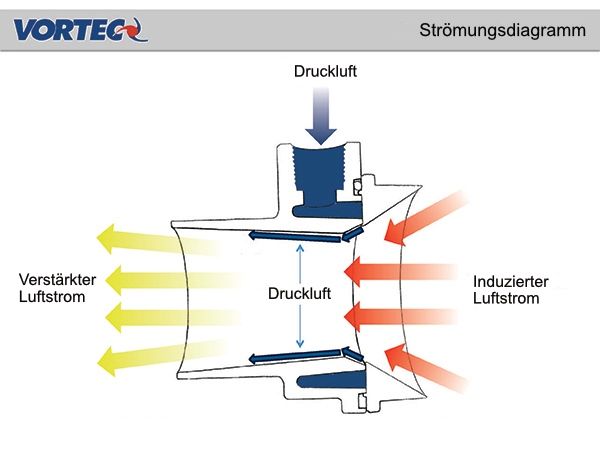
Airflow boosters utilize the Coanda effect, a phenomenon in which a jet of air adheres to a nearby surface. The key characteristic is that the airflow clings to the curved surface, even if it curves away from the jet stream. To significantly increase airflow, compressed air is combined with ambient air and drawn into the booster unit. As the compressed air mixes with the ambient air, it becomes a "mixed" air mass with a much higher velocity and force than before. This is why airflow boosters require only a small amount of compressed air to achieve a substantial increase in airflow. The Coanda effect is the same phenomenon that enables aircraft to generate the lift necessary for takeoff.
Would you like to try VORTEC components in your production? We'd be happy to help! Contact us at +49 5130 37 99 99 or vertrieb@rhdgmbh.de and we'll be pleased to advise you without obligation.
Source: Air Flow Amplifiers improve cooling time (vortec.com)