
Packaging manufacturers can experience fires in their coating areas caused by sparks of high static charge. Operators facing this problem require industrial antistatic solutions to resolve it.
Depending on the distance to the material, different machines can be used in each machine section.
Ionization rods may be required. Also, various types of rollers through which the material passes.,
This affects the static charge of the track. Special attention must be paid to safety.
required if it is an explosion-proof area where the use is exclusively ATEX-certified
discharge rods is permissible.

To determine precisely where the static charge is generated and where a discharge is necessary, various measurements must be taken. To measure the exact static charge, a FMX handheld measuring device or a IQ sensor bar Recommended for inline measurement.
Unwinding plastic films can cause static charges of up to 20 kV or more, and the film must be neutralized immediately after unwinding. This can be achieved by installing a
High-performance discharge rod It also prevents static electricity from attracting dust particles.
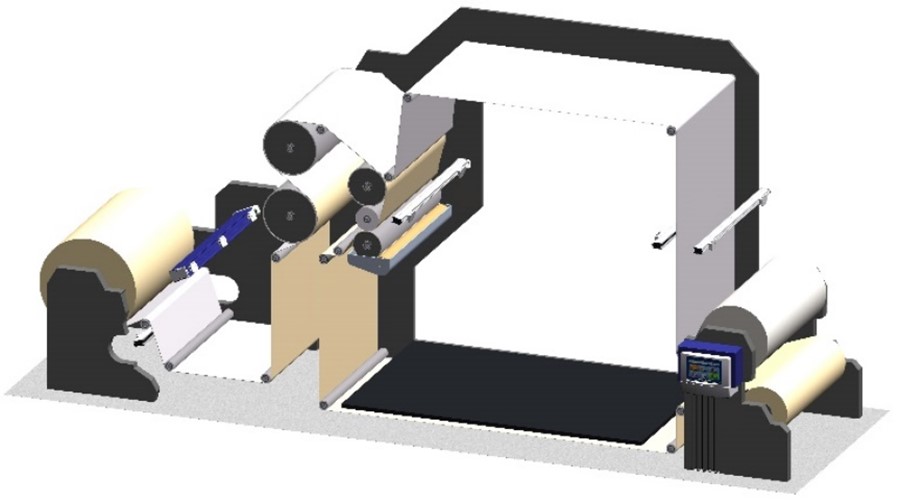
When the material undergoes corona pretreatment, a massive static charge is generated.
Materials are generated and a controlled discharge system (in Close Loop Feedback; CLFB) is recommended.
Before the material enters the recoater (ATEX zone), both sides of the material must be
must be discharged to prevent the existing static charge from acting as a potential ignition source.
functions that can lead to a fire.
Inside the coater, the material passes through several rollers, creating a static charge.
ATEX-certified ionization bars neutralize static charge on both sides of the track to prevent it from acting as a potential ignition source. The pollution and
The efficiency level is monitored by the IQ Manager. If the efficiency falls below a pre-programmed level, the PLC or the operator receives a warning so that they can service the indicated ionization bars.
During the drying process, the material can recharge due to temperature fluctuations in the dryer. Here, and also before the lamination process, 24V ionization bars neutralize the material and prevent the static charge from becoming trapped between the layers.
During rewinding, high static charges can be generated on the material again due to the pressure rollers, which can lead to electric shocks for the operator in close proximity to the material. Since the distance between the discharge bar and the material changes, especially in the reversing rewinder, a
ThunderIon discharge rod required to effectively eliminate the static charges that arise during the final winding.
Additional requirements regarding static charge or ensuring personal safety can be met with the IQ Manager system with static inline measurement and closed-loop feedback technology.
The IQ Manager It can be connected directly to the machine's PLC via a fieldbus connection. An alarm function warns the operator if the static charge reaches a dangerous level. Inline measurement and data acquisition of static charge levels can be used in quality reporting. In this way, the Manager IQ system provides all the essential information to increase personnel safety and minimize the likelihood of new fires.
Would you like to learn more about the effects of static electricity?
Then download our directly from our homepage manual „"Electrostatics in production" with 5 further specific application examples.