

Dust problems in injection-molded parts – production
Greyish haze Massive dust particle infestation is a major problem, especially for visible components such as displays, painted parts, lenses, headlight reflectors, etc. The problems are even greater in the food and medical sectors, as dust particles on injection-molded parts can also provide breeding grounds for germs.
In the first few hours after the injection molding process, polymers and additives outgas from the material in increased amounts. If there is no dust or only loosely settling dust on the injection-molded parts, this dust can easily be blown off. However, if the dust is electrostatically attracted, the dust pressed onto the surface by the adhesive forces is effectively cross-linked by the outgoing substances and bonds to the surface of the molded part. The only remaining options are vigorous rubbing, which in turn increases the charge on the surfaces, or washing the parts (which is time-consuming and energy-intensive).

Dust attraction begins even at charging voltages as low as 800 volts. For every 10 kilovolts, the radius of active dust attraction in free space increases by approximately one meter! This means that with a charging voltage of 40kV, dust and particles from an area of up to 4m can land on your injection-molded part!
Our ionizers from our partner SIMCO can help here. With these products, you can safely discharge charged injection-molded parts in a targeted and customized way, effectively preventing contamination, tailored to your specific production needs.
HERE Here you will find a selection of our current SIMCO ionizers – for a customized solution, please feel free to call one of our expert consultants!
Dust problems with injection-molded parts – filling and transport
Neutralize injection-molded parts before filling them into cartons
Often, your charged injection-molded parts cannot be neutralized directly at the point of storage, or you may want to prevent recharging in the transport containers.
Neutralizing the tape is usually not very successful., This is because the charge fields are deflected against the belt and are therefore not "visible" to the ions. Furthermore, ionization only ever reaches one side of the parts. The remaining residual charge is then sufficient to cause your parts to stick to the conveyor belt.
Your solution: Depending on the spatial conditions, a SIMCO high-performance ionizer mounted above the end of the conveyor belt (ranges typically 400 to 1500 mm) can deliver excellent results even without any air assistance. The application shown below features a SIMCO 24-volt PerforMAX Easy rod with a range of up to 500 mm.
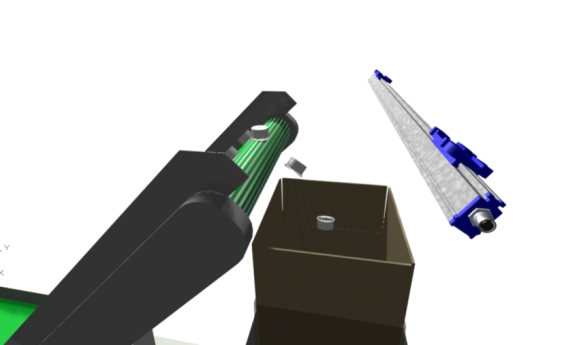
- Their products are neutralized at the last possible moment and are usually reached from all sides, as the entire zone becomes highly enriched with ions. Their particles fall through a "cloud".
- New charges generated by parts moving within the box are neutralized immediately without the need for additional equipment.
- Your conveyor belt is still neutralized in every cycle, thus attracting less dust. The ions reach the entire conveyor belt because your products no longer shade it (especially with larger parts, you can often see exactly where the parts were located after some time).
To avoid additional problems, you should generally refrain from using fans if your application allows it. You will be rewarded with less maintenance, as there will be no outside air intake and less or even no dirt ingress.
Your solution: By immediately eliminating the charge buildup with our high-performance ionizers, your problems in these areas are reduced simply and effectively.
Feel free to watch one of our short informational videos in which we introduce our IQ Manager system, which is ideally suited for comprehensive control of static electricity in your production.
We would be happy to work with you to find a solution Your problems related to electrostatics – Give us a call +49 (5130) 3799-99 or write to us and arrange an appointment with one of our competent consultants.!