

You know how it is…
Dust, shavings and lint are attracted to surfaces in your production by electrostatic charges and adhere very strongly.
Conventional wiping with cloths or normal blowing with compressed air guns only yields moderate results. After cleaning, the surfaces are even more statically charged than before and attract dirt more readily.
Static charges on surfaces cause disruptions to paint and coating structures and impair your production.
In this article, we provide information and application possibilities on how you can reduce or discharge electrostatic charges in your production, e.g., during deep drawing or painting.
So what can I do?
Static charges on non-conductive surfaces do not dissipate.
Therefore, we introduce freely moving charge carriers (ions) to the surfaces to discharge the static charge. This is achieved through the use of ionized air – a process that has been successfully used in industry for decades in paint shops and at manual workstations.
How does that work?
High voltage is applied to an emitter inside the gun – don't worry, it's touch-safe. This briefly splits the surrounding air into positive and negative charge carriers. The ions are carried by the blowing air to the charged areas on the surfaces and attach themselves to these surface charges. The surface appears neutral, and disruptive effects, especially when processing plastics, such as dust attraction, clogging (e.g., plastic chips), repulsion (disruptions to the paint finish), sparking (ignition of cleaning agents), and electric shocks to employees, are avoided.
What can I use this for?
Ionization guns are used when surfaces need not only to be freed from existing particles, but also to prevent new dust attraction.
• Removal of static electricity caused by peeling off the protective plastic films.
• Charges can interfere with the paint finish during painting. Blowing off residual charges removes them, allowing the paint to flow only according to the surface structure and surface tension, without being affected by static electricity.
• Blowing and clearing during the machining and cutting of semi-finished products made of non-conductive materials or non-conductive surfaces. Important: always blow off air from both sides. Charges are present on all surfaces, and the fields of charge act through the objects.
Are there any other advantages?
By eliminating the adhesion between the particles and the surfaces, much less pressure can be used for blow-off, thus reducing compressed air costs. (e.g., 4mm nozzle, using 25%),
4 bar: approx. €1,800/year. With 2 bar savings, approx. €800/year).
By using bubbles with reduced pressure, the particles are dispersed in a smaller area and can be captured more easily and with less energy expenditure by any existing extraction system.
The reduced pressure also lowers the noise pollution.
Which pistol should I get?
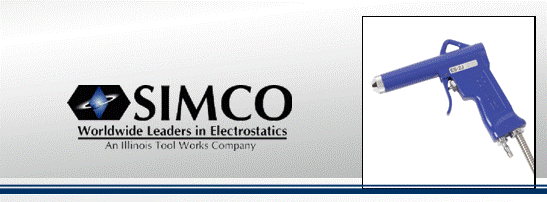
The ES-2J, with its robust yet lightweight blue die-cast aluminum housing, is used wherever smaller areas, containers, or openings need to be safely blown out. The gun can be attached to a balancer (spring-loaded) using the mounting eyelet.
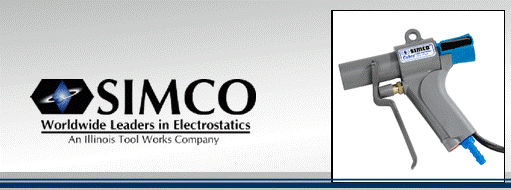
The grey Cobra clearly demonstrates its advantages when blowing off large
Surfaces. The 26 mm outlet opening allows for a large volume flow of exhaust air.
The key point: Only one-sixth of the usable air comes from your compressed air network!
We would be happy to show you exactly how this works in your production.! Call us to discuss how we can manage the electrical charges in your production!
You can also find more detailed information about ion spray guns in our online shop: www.rhdgmbh.com/shop