

Static means motionless.
Static electricity is therefore motionless electric charge.
All materials are made up of atoms. An atom is the smallest particle of a material that still exhibits the properties of that material.
Every atom consists of a positively charged nucleus around which one or more negatively charged electrons move. In its resting state, the positively charged nucleus equals the sum of the negative charges of the electrons orbiting it. Therefore, the charge is neutral.
An imbalance occurs when the nucleus gains or loses more electrons.
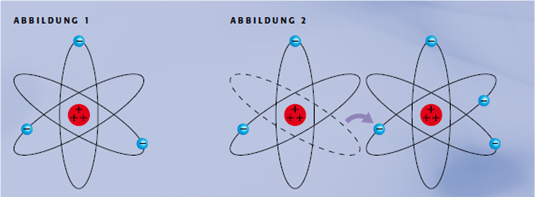
An atom that has lost one or more electrons has a positive charge, and an atom that has gained one or more electrons has a negative charge and is called an ion.
There are only two types of charges: positive and negative.
Like charges repel each other, and unlike charges attract each other.
How is static electricity generated?
Static electricity is a surface phenomenon that occurs when two or more surfaces touch and are then separated.
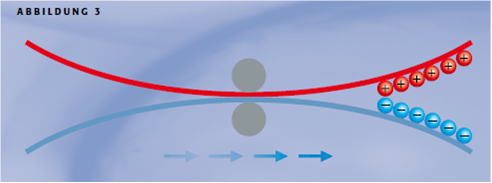
This essentially results in a splitting or transfer of negative electrons from one atom to another.
The magnitude of the charge (the field strength) depends on several factors: the material and its physical and electrical properties, temperature and humidity, and the pressure and speed of separation.
The higher the pressure or the speed of separation, the higher the charge.
Conductive and non-conductive (insulating) materials
Materials are divided into two main groups: conductors and insulators.
Electrons can move freely in a conductor.
An isolated conductor can, in principle, accumulate a static charge. This charge can be easily removed by connecting the conductor to the ground.
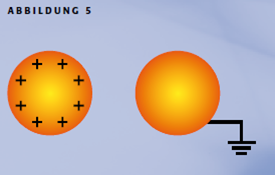
Non-conductive material can retain static charge for a long time, even with opposite polarities at different points. The electrons cannot move freely.
This explains why materials can be attracted in some areas and repelled in others. A connection with the earth remains ineffective because the material has insulating properties.
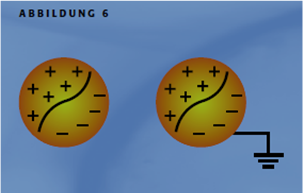
The only solution to this is active ionization.
What are the consequences?
- In production processes, static charge often represents a serious disruptive factor, as materials stick to each other or to machine parts.
- Operating personnel are at risk of electric shock.
- The static charge attracts dust from the surrounding area.
- In potentially explosive atmospheres, a spark caused by static discharge can trigger a fire or even an explosion.
How can static electricity be controlled?
The neutralization of static charge on non-conductors is achieved through active ionization.
At the high-voltage peaks of these devices, air molecules are separated into positive and negative ions.
The static charge on the product attracts ions of opposite polarity, thus neutralizing the material.
Simco offers a wide range of equipment, from which the product best suited to specific production processes or applications can be selected.
Static electricity can also be useful. High voltage can be used to apply static electricity to materials, causing them to temporarily stick together and thus simplifying production processes.
In short: Simco offers devices for measuring and controlling static electricity.